Overnight CPI data for Australia showed a much lower than expected CPI number which send the AUD down against the USD.
The Australian Dollar (AUD) fell sharply after the latest Consumer Price Index (CPI) report came in lower than expected. This unexpected inflation data has significant implications for traders, investors, and anyone monitoring Australia’s monetary policy. Let’s break down the key factors behind this move and what it means for the markets.
Broker Review Contents
Market reaction: AUD USD and ASX200
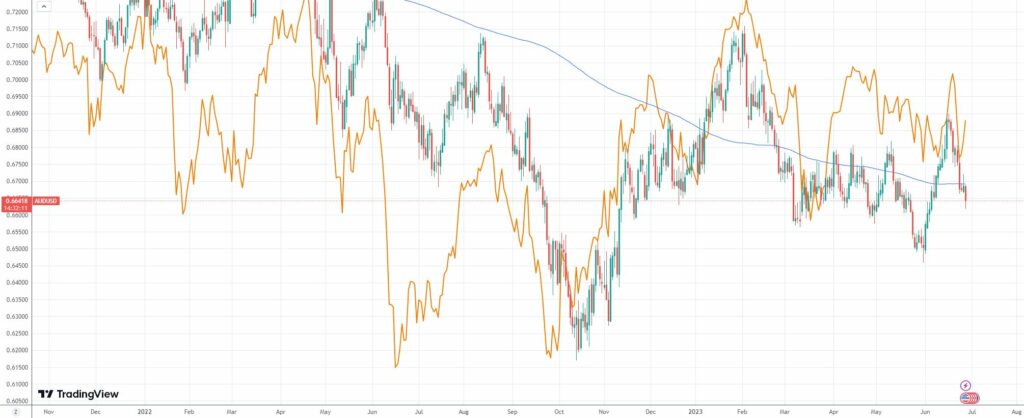
AUDUSD(candlestick) vs ASX200(yellow line) chart
The Australian dollar weakened after the release and the ASX200 made gains. This comes in as a normal reaction due to the currency in which the index is priced in weakening. It could also mean that traders are now expecting less rate hikes to follow from the Australian central bank.
In our view we think it’s likely that the AUDUSD pair won’t have a clear trend going forward as both Central Banks are likely to do a few more hikes. We expect the AUDUSD rate to keep oscillating around the 200-day SMA.
Looking ahead to 2025, the Australian economy is expected to continue navigating a path of moderate growth and controlled inflation. With the Reserve Bank of Australia maintaining a cautious approach to interest rates, traders should watch for key economic indicators such as CPI, employment figures, and trade data to gauge future market movements. The AUDUSD pair is likely to remain sensitive to global monetary policy shifts, especially from the US Federal Reserve. Staying informed on these developments will be crucial for forex traders aiming to capitalize on Australia’s evolving economic landscape in 2025. For the best trading experience, make sure to choose a reliable forex broker tailored to your needs.
Want to trade AUDUSD? Compare and find a Forex broker which suits your trading needs by clicking the button below.
What is the Consumer Price Index (CPI)?
The Consumer Price Index (CPI) is one of the most important economic indicators for measuring inflation. It tracks the average change in prices of a basket of goods and services over time. Economists, central banks, and traders closely watch CPI to gauge the health of an economy and anticipate monetary policy moves.
There are two main types of CPI:
- Headline CPI: Includes all items in the basket, reflecting overall inflation.
- Core CPI: Excludes volatile items like food and energy to provide a clearer picture of underlying inflation trends.
Lower CPI readings suggest inflation is under control, while higher CPI readings indicate rising price pressures.
Why Lower‑Than‑Expected CPI Matters
When CPI comes in below market expectations, it can signal slower inflation than predicted. For traders, this can lead to a reassessment of interest rate expectations. If inflation is weaker, the Reserve Bank of Australia (RBA) may pause or slow future rate hikes, reducing the attractiveness of holding AUD-denominated assets.
In this instance, the recent CPI print was below analyst forecasts, triggering a swift negative reaction in the AUD.
Why the AUD Fell
The Australian Dollar depreciated after the lower CPI data for a few key reasons:
- Lower Interest Rate Expectations: Softer inflation reduces the likelihood of aggressive rate hikes by the RBA.
- Market Sentiment: Traders reacted by selling AUD in favor of other currencies with higher yield potential.
- Global Risk Dynamics: A weaker AUD often reflects reduced confidence in Australia’s short-term economic growth.
In short, lower inflation makes the AUD less attractive to investors, prompting a sell-off.
Impact on RBA Monetary Policy
The Reserve Bank of Australia monitors CPI closely when deciding on interest rates. Lower inflation gives the RBA more flexibility to maintain or cut rates if needed.
Potential implications include:
- Delayed rate hikes: Any planned increases could be postponed.
- Rate cuts more likely: If inflation continues to trend below target, the RBA may consider easing monetary policy.
Traders often price these expectations into AUD trading, meaning even subtle CPI shifts can have a large market impact.
Market Reactions Beyond the AUD
CPI does not just affect the AUD. Broader markets also respond:
- Equities: Lower inflation may support stock markets if borrowing costs remain low.
- Bonds: Softer CPI can lead to declining yields as rate hikes become less likely.
- Risk Sentiment: Traders may shift between risk-on and risk-off assets depending on the inflation outlook.
Understanding these dynamics helps investors position themselves across multiple markets.
Technical Reaction on AUD Pairs
From a technical perspective, the AUD/USD pair showed clear signs of short-term bearish momentum:
- Support levels tested near previous lows.
- Resistance zones strengthened as selling pressure increased.
- Momentum indicators (like RSI and MACD) suggested continued downside risk in the near term.
Combining technical and fundamental analysis allows traders to make more informed decisions.
Comparative Impact of Global CPI
Australia’s CPI does not exist in isolation. Other major economies’ inflation data—such as the US CPI or China CPI—can influence AUD movement due to:
- Trade relationships
- Carry trade flows
- Global monetary policy expectations
A synchronized slowdown in global inflation often reinforces AUD weakness.
Upcoming Key Economic Data
After this CPI print, traders will monitor additional Australian economic indicators, including:
- Employment data
- Retail sales
- GDP growth figures
These releases will help determine whether the lower inflation trend is temporary or a sign of broader economic weakness.
Trading Strategies & Risk Management
For traders looking to navigate AUD volatility:
- Use stop-loss orders to manage risk during high-impact releases.
- Combine technical and fundamental analysis for better entry/exit points.
- Monitor RBA statements and minutes for hints on policy direction.
- Avoid over-leveraging; unexpected CPI surprises can trigger rapid moves.
Careful positioning is key to capitalizing on opportunities while mitigating losses.
Long-Term Macro Themes
Lower-than-expected CPI highlights broader trends in the Australian and global economy:
- Slower inflation may limit the RBA’s ability to hike rates aggressively.
- Global monetary easing cycles influence AUD’s attractiveness versus other currencies.
- Yield differentials remain critical for forex traders in positioning for short-term and long-term trends.
Investors should consider these factors when planning medium- to long-term strategies.
FAQs
1. What is CPI and why is it important for the AUD?
The Consumer Price Index (CPI) measures the average change in prices of goods and services. It’s important for the AUD because it influences the Reserve Bank of Australia’s interest rate decisions, which directly affect the currency’s value.
2. Why did the AUD fall after the latest CPI report?
The AUD fell because the CPI came in lower than expected, signaling weaker inflation. This reduces the likelihood of RBA rate hikes, making the AUD less attractive to traders.
3. How does CPI affect the Reserve Bank of Australia’s monetary policy?
CPI is a key indicator for the RBA. If inflation is below target, the RBA may delay rate hikes or consider easing monetary policy, which can impact currency strength.
4. Can global CPI reports influence the AUD?
Yes. Inflation data from major economies like the US or China can affect AUD movements due to trade relationships, global interest rate expectations, and risk sentiment.
5. What should traders do when CPI surprises the market?
Traders should use stop-loss orders, combine technical and fundamental analysis, and monitor central bank statements. Managing leverage and risk is crucial during volatile CPI releases.