Gold — traditionally viewed as the ultimate safe-haven asset — has displayed a surprisingly muted price response even amid elevated geopolitical tensions surrounding Russia. This divergence from historical patterns has puzzled investors and traders alike. Why isn’t gold rallying like it has in past crises? Let’s unpack the fundamental, technical, and macro forces behind this unusual behavior and explore what this means for markets going forward.
Broker Review Contents
Russia Situation didn’t generate demand
The Wagner – Putin conflict didn’t seem to affect gold price and generate demand for haven which would normally be expected. Granted the situation was largely resolved by the market open on Monday, but still the political and military establishment in Russia has been severely shaken.
In our view this shows that it is likely that we see another move lower in the precious metal’s price.
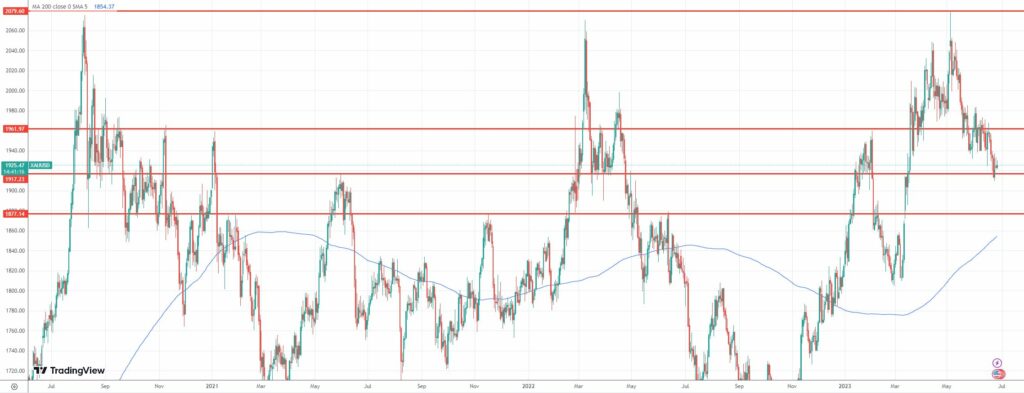
Gold/USD daily chart
Gold Technical analysis
As of writing of this piece Gold was trading around 1925. There is support standing around 1917, and the monthly low is around 1910. For a more significant move lower, a strong move below these two price levels needs to occur first. Then comes the 1900 handle and next support below that would be 1877 and the 200-day sma.
We don’t see this move materializing fast and, in our view, it will likely occur in July.
The scenario for upside move can occur if something changes fundamentally and risk assets start selling off. Then we can see a quick move towards the resistance of 1961 and after that another attack of the all-time highs.
As we move through 2025, gold prices remain influenced by a mix of macroeconomic trends, central bank policies, and shifting geopolitical landscapes. With interest rate decisions from the Federal Reserve and inflation data continuing to drive market sentiment, traders should keep a close eye on key support and resistance levels. Additionally, any renewed geopolitical tensions or unexpected market shocks could reignite demand for safe-haven assets like gold. For those looking to capitalize on gold market trends in 2025, choosing a trusted gold broker with competitive spreads and strong market analysis tools is essential for successful trading.
Want to trade gold? Compare and find a gold broker which suits your trading needs by clicking the button below.
What Is Gold’s Traditional Safe-Haven Role?
Gold has long been regarded as a hedge against uncertainty. During periods of war, political instability, financial turmoil, or currency weakness, investors typically flock to gold to preserve capital. Historically, major events such as the:
- Global Financial Crisis (2008–2009)
- Eurozone sovereign debt crisis
- Early stages of the Ukraine conflict
…all coincided with notable rallies in gold prices as traders sought safety.
This pattern is rooted in gold’s unique characteristics:
- It holds intrinsic value outside of any single government or currency
- It isn’t tied to credit or banking systems
- It often moves inversely to risk assets during stress periods
Given this, unusually high geopolitical risks — especially involving a major player like Russia — would normally bolster gold. But that hasn’t fully materialized this time.
Why Is Gold Not Responding Strongly This Time?
Multiple interconnected factors are dampening the traditional safe-haven bid for gold, even amidst geopolitical instability:
1. The U.S. Dollar Remains Strong
Gold and the U.S. dollar usually have a negative correlation — when the dollar rises, gold tends to struggle, and vice versa.
Recent strength in the dollar has absorbed much of the “flight to safety” flows, weakening gold’s upside potential.
Why the strong dollar?
- Ongoing interest rate differentials between the U.S. and other regions
- Continued demand for dollar financing globally
- Perceived safety of U.S. Treasuries relative to other assets
A robust dollar makes gold more expensive for holders of other currencies, reducing demand.
2. Monetary Policy Is a Dominant Force
Global central banks — including the U.S. Federal Reserve — have shifted focus toward inflation control and interest rates.
Unlike past crises where rate cuts and quantitative easing drove yields lower (pushing investors into gold), current monetary policy is more hawkish. Higher interest rates raise the opportunity cost of holding non-yielding assets like gold.
This dynamic outweighs the traditional geopolitical safe-haven bid that might otherwise support gold prices.
3. Risk Appetite Has Not Collapsed
While geopolitical tensions in Russia remain high, broader financial markets have not fully entered a risk-off mode. Equity markets and credit instruments have shown resilience, indicating that:
- Investors are not aggressively reducing risk
- Liquidity is still ample
- Safe-haven crowds may be smaller than expected
Gold rallies most when fear is pervasive — something that hasn’t fully registered yet in markets.
4. Alternative Safe Havens Are Absorbing Flows
Some investors have rotated into:
- U.S. Treasuries
- Cash and short-term instruments
- Major currencies (especially the U.S. dollar)
- Crypto assets in select speculative strategies
These alternatives compete with gold for “safe-haven capital,” damping gold’s responsiveness.
Gold Price Technical Analysis: What the Charts Suggest
Looking at the price structure provides insight into gold’s subdued behavior:
Support Levels
Gold has found near-term support around key psychological and technical zones, including:
- $1,800 per ounce
- $1,780 intermediate support
These levels reflect traders stepping in to defend downside risk.
Resistance Levels
On the upside, gold needs to clear:
- $1,840–$1,860
- $1,900 psychological zone
Without breaking these barriers, momentum remains sluggish.
Indicators
- RSI (Relative Strength Index): Near neutral — not signaling oversold or overbought conditions
- MACD: Mixed signals, suggesting consolidation rather than directional strength
Overall, the technical picture reflects hesitation, not panic.
How Geopolitical Risk Normally Affects Gold — And Why It’s Different Now
Gold typically rises during geopolitical stress because:
✔ Investors seek capital preservation
✔ Risk assets underperform
✔ Confidence in financial markets declines
✔ Currency and credit uncertainty rises
However, the current environment diverges from these classic conditions:
- Financial markets remain relatively stable
- Central banks are prioritizing rate policy over crisis responses
- Market participants may assign more influence to macro data than geopolitical headlines
In this context, gold’s lackluster performance isn’t random — it reflects evolving market priorities.
What This Means for Investors & Traders
For Long-Term Investors
If your thesis on gold is wealth preservation over decades, short-term muted reactions don’t necessarily undermine its role in a diversified portfolio. Real interest rates, inflation expectations, and monetary policy still influence gold’s long-term direction.
For Traders
Short-term traders may view gold’s current behavior as an opportunity to:
- Trade range dynamics between support/resistance
- Use volatility to scalp or swing trade
- Monitor key macro events for breakout catalysts
But caution is warranted — gold’s volatility is context-dependent and can spike quickly during unexpected shocks.
Key Events to Watch That Could Reignite Gold
Gold may break out if any of the following materialize:
1. Escalation of the Geopolitical Conflict
Major developments or unexpected escalation around Russia could trigger a sharper safe-haven bid.
2. Sudden Global Risk Aversion
If equity markets sell off sharply or credit spreads widen, gold often benefits.
3. Central Bank Policy Surprises
A pivot from tightening to easing — especially by the Federal Reserve or ECB — could boost gold.
4. Inflation Surprises
Renewed inflation spikes without offsetting monetary policy could make gold more attractive.
5. Currency Volatility
Greater weakness in major currencies aside from the dollar could support gold.
FAQs
1. Why isn’t gold rising despite high geopolitical risks in Russia?
Gold’s muted reaction is mainly due to a strong U.S. dollar, higher interest rates, and stable global markets. These factors are limiting the traditional safe-haven demand for gold.
2. Does gold always rise during geopolitical conflicts?
Not always. While gold is considered a safe-haven asset, its price is also influenced by interest rates, real yields, currency strength, and overall market sentiment.
3. How do interest rates affect gold prices?
Higher interest rates increase the opportunity cost of holding gold, which does not pay interest. Rising real yields typically put downward pressure on gold prices.
4. What could trigger a strong gold rally?
Gold could rally if geopolitical tensions escalate significantly, global markets enter a risk-off phase, inflation rises sharply, or central banks shift toward rate cuts.
5. Is gold still a good hedge during uncertain times?
Yes, gold remains a long-term hedge against inflation and systemic risk. However, short-term price movements depend on macroeconomic conditions and currency trends.