S&P 500: Where Next?
Broker Review Contents
Introduction: Why the S&P 500 Matters
The S&P 500 index is widely regarded as the most important benchmark for the US stock market. Representing 500 of the largest publicly traded companies in the United States, it reflects the overall health of corporate America and plays a central role in global investment decisions.
In 2026, investors are asking a critical question: where is the S&P 500 heading next? After years of strong performance, periods of volatility, and shifting economic conditions, understanding the index’s future direction requires a careful look at fundamentals, macroeconomic trends, and market risks.
This analysis explores possible scenarios for the S&P 500, helping investors assess whether the index is likely to move higher, consolidate, or face renewed downside pressure.
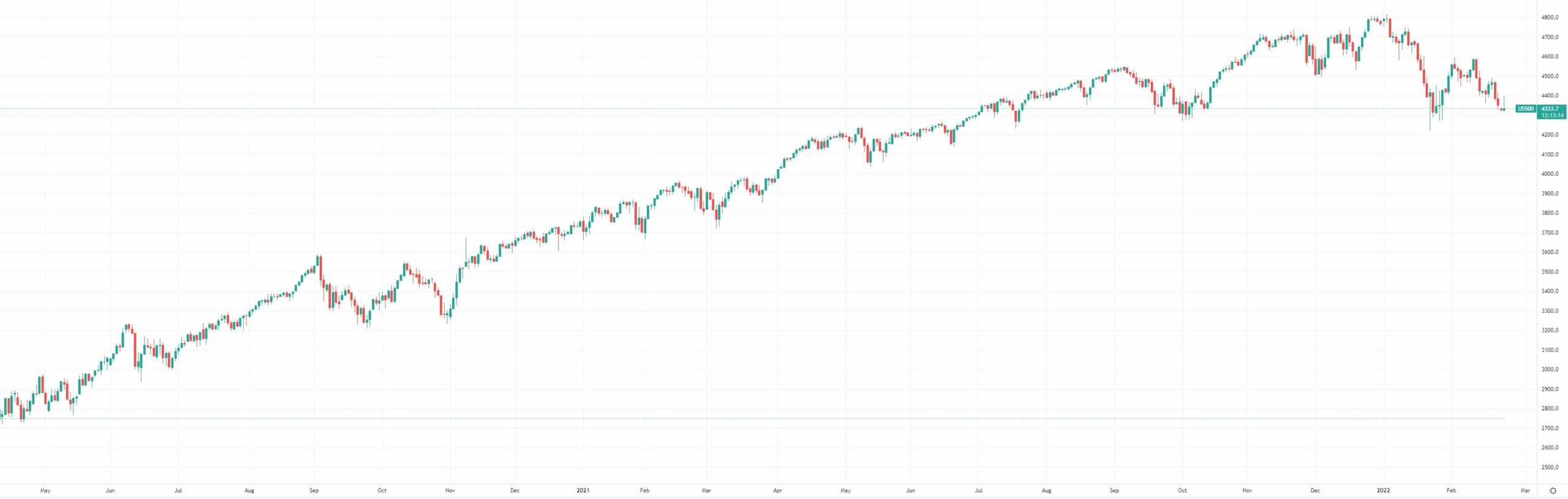
S&P 500 Daily Chart
What Drives the S&P 500?
Before predicting where the S&P 500 may go next, it is important to understand what actually drives its performance.
Key drivers include:
- Corporate earnings growth
- Interest rate policy
- Inflation trends
- Economic growth and employment
- Investor sentiment and liquidity
Because the index is heavily weighted toward large technology and growth companies, movements in a small number of mega-cap stocks can significantly influence overall performance.
Current Market Environment in 2026
Economic Growth Outlook
In 2026, economic growth in the United States remains moderate but uneven. While consumer spending and employment remain relatively resilient, higher borrowing costs and tighter financial conditions continue to weigh on certain sectors.
A slowing economy does not automatically mean falling stock prices, but it does affect earnings expectations, which are critical for market direction.
Interest Rates and Federal Reserve Policy
Interest rates remain one of the most important factors for the S&P 500.
Key considerations include:
- Whether the Federal Reserve maintains restrictive policy
- Timing and pace of potential rate cuts
- Impact of rates on corporate borrowing and valuations
Higher interest rates tend to pressure stock valuations, especially growth stocks, while lower rates often support equity markets.
Corporate Earnings: The Foundation of Market Direction
Ultimately, the S&P 500 follows corporate earnings over the long term.
Earnings Trends
In 2026:
- Earnings growth is positive but slower than during post-pandemic recovery years
- Margins face pressure from wages and input costs
- Companies with strong pricing power perform better
If earnings continue to grow steadily, the S&P 500 may remain supported even without rapid economic expansion.
Valuation: Is the S&P 500 Expensive?
Valuation plays a key role in determining future returns.
Key points:
- The S&P 500 trades above long-term historical averages at times
- High valuations do not guarantee a crash but limit upside potential
- Future returns may be lower than past decade averages
Investors should not rely solely on valuation, but it provides important context for expectations.
Technology Sector Influence
Technology companies represent a significant portion of the S&P 500’s market capitalization.
Key factors:
- Continued innovation in artificial intelligence and cloud computing
- Slower growth for mature tech giants
- Increased regulatory scrutiny
Strong performance from a handful of large tech stocks can lift the index even when broader participation is weak.
Inflation and Its Market Impact
Inflation remains a key variable in 2026.
- Persistent inflation pressures can delay rate cuts
- Lower inflation supports valuations and consumer spending
- Unexpected inflation spikes may trigger market volatility
Markets tend to react quickly to inflation data, making it a short-term driver of price swings.
Global Risks Affecting the S&P 500
The S&P 500 is influenced not only by US factors but also by global developments.
Major risks include:
- Geopolitical tensions
- Trade policy uncertainty
- Global economic slowdowns
- Currency fluctuations
These risks can affect multinational companies that derive significant revenue from outside the United States.
Bullish Scenario: How the S&P 500 Could Move Higher
A positive outlook for the S&P 500 in 2026 would likely involve:
- Continued earnings growth
- Gradual easing of monetary policy
- Stable inflation trends
- Strong consumer demand
In this scenario, the index could experience moderate gains rather than explosive rallies, reflecting a more mature market phase.
Bearish Scenario: What Could Drive a Decline
A downside scenario could emerge if:
- Earnings disappoint significantly
- Interest rates remain high for longer than expected
- Economic growth weakens sharply
- Financial conditions tighten abruptly
Market corrections are a normal part of long-term investing, and even strong bull markets experience pullbacks.
Sideways Scenario: Consolidation and Range Trading
Another realistic outcome is sideways market movement.
Characteristics of this scenario:
- Periods of rallies followed by pullbacks
- Index trades within a broad range
- Stock selection becomes more important than index exposure
This environment often favors active management and sector rotation.
Long-Term Perspective on the S&P 500
Historically, the S&P 500 has delivered positive returns over long periods, despite short-term volatility.
Key lessons:
- Timing the market consistently is extremely difficult
- Long-term investors benefit from patience and diversification
- Short-term fluctuations matter less over decades
For long-term investors, the index remains a core portfolio component, even during uncertain periods.
Common Mistakes Investors Make With the S&P 500
- Chasing performance after strong rallies
- Panic selling during corrections
- Over-concentration in one index
- Ignoring valuation and risk management
Avoiding emotional decisions is critical when investing in broad market indices.
Risk Management for S&P 500 Investors
Practical risk management approaches include:
- Diversification across asset classes
- Gradual investing rather than lump sums
- Rebalancing portfolios periodically
- Aligning exposure with risk tolerance
No market outlook is guaranteed, making risk control essential.
What does Goldman Sachs say about the S&P 500?
In a recent podcast, Goldman Sachs Chairman and CEO David Solomon discussed the market valuation at large. Whilst he confirms overvaluation on the basis of earnings data and implementation of policies aimed at targeting inflation pointing to further downside, he also suggested that growth stocks have experienced reasonable correction. Since then, we are continuing to see further decline in the S&P 500 index, and the answer could lay nowhere other than in the geopolitical tensions between US and Russia over Ukraine invasion. Safe haven assets are gaining more traction as investors await Putin’s actions, with the price of gold spiking by over 5% across February.
Is the potential invasion of Ukraine really the reason behind the recent moves of the S&P 500?
Analysts mostly agree that the effects of geopolitical tensions on the market are relatively short-lived. Paul Shatz, the president of Heritage Capital, claims that the decline we are seeing is hardly a result of Ukraine-Russia tension and is purely led by Fed promise of interest rate hikes and central bank’s balance sheet reduction. Accordingly, we may begin seeing recoveries in the S&P 500 towards the end of 2022/ early 2023, with the market establishing a consolidating structure prior to another bull run. Furthermore, the mini V shape spikes historically suggest that we are not yet approaching a bottom of the market’s decline.
How do interest rate hikes affect indices?
Speculations, over how many rate hikes we are yet to see, appear futile. If the market begins to show signs of aggressive downward momentum it might prove difficult for the Fed to hike further. Sharp increases could also inhibit economic growth in general. In fact, Clissold and Thanh Nguyen, NDR’s senior quantitative analyst, found that historically the speed of rate hikes determines what happens to the market, with S&P 500 showing an average of 10.5% growth following a slow-tightening cycle versus a fall of 2.7% following a fast-tightening cycle. NDR expectation of 4 or more rate hikes over 2022 and speculation of kick-starting with a 50 basis points hike suggest we are approaching a fast-tightening cycle.
So what to do when fear of a market crash is looming around the corner? Investing in commodities could be the answer as they are structurally different from traditional assets. More on this in the next article.
Looking for a broker with which you can trade S&P 500? Find it here.
Written by Katherine Szewczyk. Katherine is an active trader. She featured in Women in Trading campaign for prop firm BluFx. Follow her on twitter for more updates.
In 2026, the S&P 500 faces a more balanced outlook than in past high-growth periods. While long-term fundamentals remain intact, near-term performance will likely depend on earnings trends, interest rates, and inflation developments.
Rather than expecting extreme outcomes, investors may need to prepare for moderate returns, increased volatility, and periods of consolidation. The index remains a strong long-term investment vehicle, but success will depend on realistic expectations and disciplined strategy.
Risk Disclaimer
This content is for educational purposes only and does not constitute financial advice. Investing in stock market indices involves risk, and past performance does not guarantee future results. Always consider your financial goals and risk tolerance before investing.
FAQs
What factors most influence the direction of the S&P 500?
The S&P 500 is mainly influenced by corporate earnings, interest rates, inflation, economic growth, and Federal Reserve policy. Large technology companies also play a significant role due to their heavy weighting in the index.
2. Is the S&P 500 overvalued in 2026?
Valuation levels in 2026 are above long-term historical averages, which may limit future returns. However, higher valuations do not necessarily mean an immediate market decline, especially if earnings continue to grow.
3. Can the S&P 500 continue to rise if economic growth slows?
Yes, the S&P 500 can still rise during periods of slower economic growth if corporate profits remain stable, inflation eases, or interest rates decline. Market performance does not always move in direct alignment with economic data.
4. Is the S&P 500 suitable for long-term investors?
The S&P 500 has historically been well suited for long-term investors due to its diversification across major US companies. Short-term volatility is common, but long-term trends have generally been positive.
5. What are the main risks to the S&P 500 outlook?
Key risks include persistent high interest rates, earnings disappointments, inflation surprises, geopolitical tensions, and global economic slowdowns. These factors can lead to increased volatility or market corrections.



