The cryptocurrency market has always been volatile, captivating both investors and skeptics alike. From meteoric rises to steep crashes, crypto has consistently sparked debate: Is this the start of a sustained bull cycle, or are we heading toward another downturn? With 2026 underway, many analysts and traders are asking whether the stars are finally aligning for cryptocurrencies.
This article explores the factors shaping the current crypto landscape, including market performance, macroeconomic drivers, institutional adoption, technological advances, regulatory developments, and investor sentiment. By the end, you’ll have a comprehensive view of whether the crypto market is poised for a meaningful recovery or simply experiencing another temporary surge.
Broker Review Contents
1. Understanding the “Stars Aligning” Metaphor in Crypto
When people talk about the stars aligning, they refer to multiple positive factors converging simultaneously, creating a favorable environment. For crypto, these factors include:
- Strong market fundamentals
- Rising institutional adoption
- Regulatory clarity
- Technological advancements
- Macro conditions supportive of risk assets
In essence, if multiple bullish forces coincide, the crypto market may be poised for a sustainable upward trend rather than a temporary bounce.
2. Recent Crypto Market Performance
The past year has seen mixed performance across the crypto market:
- Bitcoin (BTC) has recovered from mid-2025 lows, demonstrating renewed investor interest.
- Ethereum (ETH) has benefited from Layer-2 scaling solutions and institutional usage of smart contracts.
- Altcoins such as Solana, Cardano, and Polygon have experienced sector-specific rallies, particularly in DeFi and NFT markets.
Volatility remains high, but certain on-chain metrics suggest renewed investor confidence. Transaction volume growth and wallet activity indicate more engagement than during the prior bear market.
3. Macro Drivers Supporting Crypto in 2026
Global macroeconomic conditions play a critical role in crypto adoption and performance:
A. Interest Rates and Monetary Policy
Lower interest rates and moderate inflation typically favor risk assets like crypto. Central banks in 2026 have been adopting a cautious approach, balancing inflation control with economic growth, which indirectly supports digital asset investment.
B. Inflation Trends
After a period of high inflation, many economies have stabilized prices. Crypto investors often view Bitcoin and Ethereum as potential hedges against inflation, which increases demand in periods of uncertainty.
C. Institutional Allocation
Financial institutions are gradually allocating portions of their portfolios to digital assets. Hedge funds, pension funds, and sovereign wealth funds are exploring crypto ETFs, futures, and staking products. These inflows can drive sustained upward pressure on prices.
4. Regulatory Clarity: A Double-Edged Sword
Regulatory developments are crucial for crypto adoption:
- United States: The SEC and CFTC have provided incremental guidance on ETFs, stablecoins, and DeFi protocols.
- Europe: MiCA regulations are creating a clearer framework for crypto service providers.
- Asia and Middle East: Countries like Singapore, UAE, and Japan are providing licenses and creating environments favorable for institutional crypto activity.
Regulatory clarity reduces uncertainty, encourages institutional inflows, and enhances investor confidence. Conversely, overly restrictive policies could limit growth, making regulation one of the key variables in market alignment.
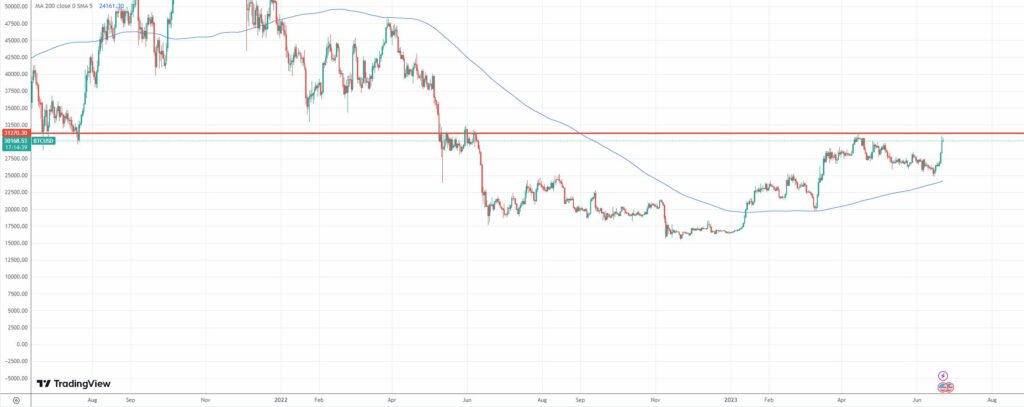
BTCUSD Spot Chart Binance
Following all these developments, BTC made a strong move to the upside which started on Monday. Yesterday the price broke above 30k USD and was within a few hundred bucks of the yearly high which stands at 31170.96. This region has been an established support/resistance which currently acts as resistance.
Breaking above this level can mean that we can see a potential for a quick move towards the 40k handle.
On the other hand, if the resistance holds, a move back towards 25-26k is likely.
Interested in trading Bitcoin?
5. Institutional Adoption and Big Money Flows
Institutional investors are increasingly active in the crypto market:
- Bitcoin & Ethereum ETFs are gaining traction among mainstream investors.
- Corporate Treasury Allocations: Some companies continue to hold crypto as part of treasury management, though more cautiously than in previous cycles.
- Hedge Fund and Sovereign Wealth Involvement: Professional funds are using crypto for diversification, particularly in portfolios seeking exposure to uncorrelated assets.
The presence of institutional capital reduces the likelihood of extreme volatility, while boosting legitimacy in the eyes of retail investors.
6. On-Chain Metrics Indicating Market Strength
On-chain data provides insight beyond prices:
- Active Addresses: Growing number of daily active wallets indicates increased user participation.
- Transaction Volumes & Fees: Higher activity suggests real usage, not just speculative trading.
- Exchange Outflows: More coins leaving exchanges often signal long-term holding intentions.
- DeFi Total Value Locked (TVL): Growth in decentralized finance platforms points to adoption and utility beyond speculation.
These metrics demonstrate that underlying network usage is strengthening — a positive alignment factor.
7. Technological Advancements Driving Adoption
Crypto adoption is supported by technology improvements:
- Ethereum Upgrades: Transition to proof-of-stake and Layer-2 solutions reduce transaction costs and energy consumption.
- Blockchain Interoperability: Protocols allowing multiple blockchains to communicate enhance utility.
- DeFi Growth: Lending, staking, and yield platforms expand financial services beyond traditional banks.
- NFT and Web3 Applications: Integration of digital assets into gaming, art, and social media increases mainstream awareness and usage.
Technological maturity provides a foundation for sustained adoption, complementing market dynamics.
8. Adoption Trends: Real-World Use Cases
Crypto is no longer just for speculation:
- Retail Wallet Growth: More individuals are holding digital assets for savings, remittances, and payments.
- Payment Adoption: Some merchants now accept crypto for goods and services.
- NFTs, Gaming, and the Metaverse: Digital ownership and in-game economies drive broader engagement and utility.
As adoption spreads, cryptocurrencies may gain resilience against market volatility.
9. Major Risks and Headwinds
Despite positive signals, the crypto market still faces significant risks:
- Regulatory Uncertainty: Abrupt policy changes can trigger sell-offs.
- Macro Downturns: Recession or rising interest rates can reduce risk appetite.
- Security Concerns: Hacks, scams, and network vulnerabilities remain threats.
- Liquidity Issues: Smaller tokens and niche projects may face liquidity problems in downturns.
These factors can disrupt the alignment of bullish forces, making risk management critical.
10. Market Sentiment and Behavioral Indicators
Investor psychology influences crypto prices:
- Fear & Greed Index: Current readings suggest cautious optimism.
- Derivatives and Funding Rates: Elevated short positions or high leverage can precede corrections.
- Social Media Signals: Trending discussions often precede price moves, reflecting retail sentiment.
Monitoring sentiment alongside fundamentals helps investors gauge short-term risk versus long-term opportunity.
11. Financial Products and Institutional Tools
The financialization of crypto enhances market stability:
- ETFs, futures, and options allow institutional investors to manage exposure.
- Tokenized stocks and staking derivatives provide alternative ways to participate.
- Yield products attract investors seeking income from digital assets.
These instruments make crypto more accessible to traditional investors, promoting alignment with broader financial markets.
12. Predictions and Forecasts for 2026–2027
While crypto remains unpredictable, several trends suggest potential alignment:
- Bitcoin and Ethereum may continue moderate recovery as institutional adoption increases.
- DeFi platforms could see steady growth, expanding utility beyond trading.
- Macro conditions such as moderate interest rates and stable inflation may support risk assets.
- Regulatory clarity is likely to reduce fear and boost mainstream participation.
Investors should track metrics like network activity, institutional inflows, and adoption trends to assess whether alignment is sustained.
13. Investment Guidance for Crypto Investors
Before investing, consider:
- Diversification: Spread holdings across multiple assets to reduce risk.
- Long-Term Perspective: Volatility is high; patience can yield better returns.
- Risk Management: Set stop-loss levels and avoid over-leveraging.
- Portfolio Fit: Ensure crypto exposure matches risk tolerance and financial goals.
- On-Chain Analysis: Monitor usage trends, DeFi TVL, and whale activity to inform decisions.
14. Conclusion: Are the Stars Really Aligning?
Several positive factors — institutional adoption, on-chain growth, macro stability, technological advances, and regulatory progress — suggest the crypto market may be entering a favorable phase.
However, risks remain: regulatory uncertainty, macroeconomic shocks, security vulnerabilities, and volatility can disrupt the alignment.
For investors with a long-term view and proper risk management, current conditions indicate a cautiously optimistic environment, but not a guarantee of sustained bull markets.
15. Frequently Asked Questions (FAQs)
- Is the crypto market bullish in 2026?
Some indicators suggest optimism, but high volatility persists. - Which cryptocurrencies are leading the recovery?
Bitcoin, Ethereum, and major DeFi-focused altcoins show strong adoption metrics. - How does regulation affect crypto prices?
Clear regulations encourage adoption and institutional flows, while restrictive policies can cause short-term drops. - Should I invest now or wait?
Timing is difficult; a long-term, diversified approach reduces risk. - What metrics indicate crypto market health?
Active addresses, transaction volumes, exchange outflows, and DeFi TVL are key indicators.